
[100% of this post was written by humans, not AI]
The European Commission’s climate unit* stubbornly refuses to correct its mistakes on bioenergy. For years, scientists (including those at the Commission!) have pointed out that logging forests for fuel:
- emits more CO2 per unit energy than fossil fuels
- is not renewable on meaningful timescales – logging then regrowing forests takes too long to help reach net zero
- degrades forests and their ability to shield us from the impacts of climate change, such as heatwaves, drought and flooding.
* Directorate General for Climate Action, “DG CLIMA”
The EU Emissions Trading System (ETS) turns a blind eye to carbon pollution emitted from biomass power plants, giving bioenergy a “zero rating” despite the IPCC recognizing that forest carbon loss from logging contributes to rising atmospheric CO2.
In reality, data from power plants regulated under the ETS shows that plants burning biomass emit about as much carbon pollution as coal and gas plants, but contribute much less energy.
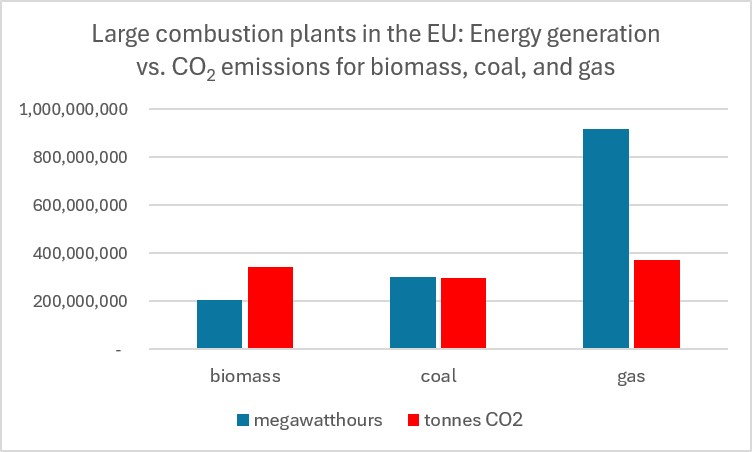
The European Science Advisory Board on Climate Change estimated bioenergy emissions as equivalent to 15.7% of the emissions that are covered by the ETS (page 148, here).
The Commission could address this problem and rein in a key driver of forest degradation by requiring plants burning biomass to purchase allowances. Unfortunately, despite input from scientists and NGOs, the European Commission has retained the zero-rating for biomass, so the ETS will continue to reward burning trees for energy.
Worse, the Commission’s proposal now “integrates permanent carbon removals”, including Bioenergy with Carbon Capture and Storage (BECCS). This means that companies will be encouraged to log forests, burn them for energy, and claim a carbon “removal” when they pipe the CO2 underground. As explained in a complaint to the Commission, all this achieves is shifting the carbon once held in forests to belowground storage – no new removal of atmospheric CO2 has occurred. Meanwhile, logging, soil disturbance, biomass transport, and the CCS apparatus all emit uncapturable carbon “upstream” of the storage operation.
And, EU industries will be allowed to offset some of their emissions by buying carbon credits from around the world. This has been limited to 2% but is still a depressing development. Carbon credits often do not represent additional activities (i.e. they’d happen anyway) and their efficacy is massively exaggerated (sometimes by orders of magnitude).
Will money for “decarbonisation” pay to cut and burn forests? The Commission says “the revised ETS will have a strong focus on investments”, amounting to more than €100 billion by 2030. That’s a lot of money to burn if the “investments” support bioenergy.
Alongside the ETS revision, the EC has announced further steps towards electrification. This could (and should) help reduce use of fuel combustion (including wood) and favouring clean renewables such as wind and solar. But in the meantime, the ETS continues to ignore the carbon loss from forests logged for fuel. For the foreseeable years, a confusing situation will unfold where the Commission encourages burning trees along with electrification.
The Commission’s proposals still have to be approved by the European Parliament and the Council of the EU. This means changes can be proposed by MEPs on the Environment Committee and Member States meeting in the Environment Council. Policymakers who want to maximize the effectiveness of the ETS should end incentives to log trees for energy – both in the ETS itself, and in the Renewable Energy Directive.


